School Gardens Revitalization Project


Vision
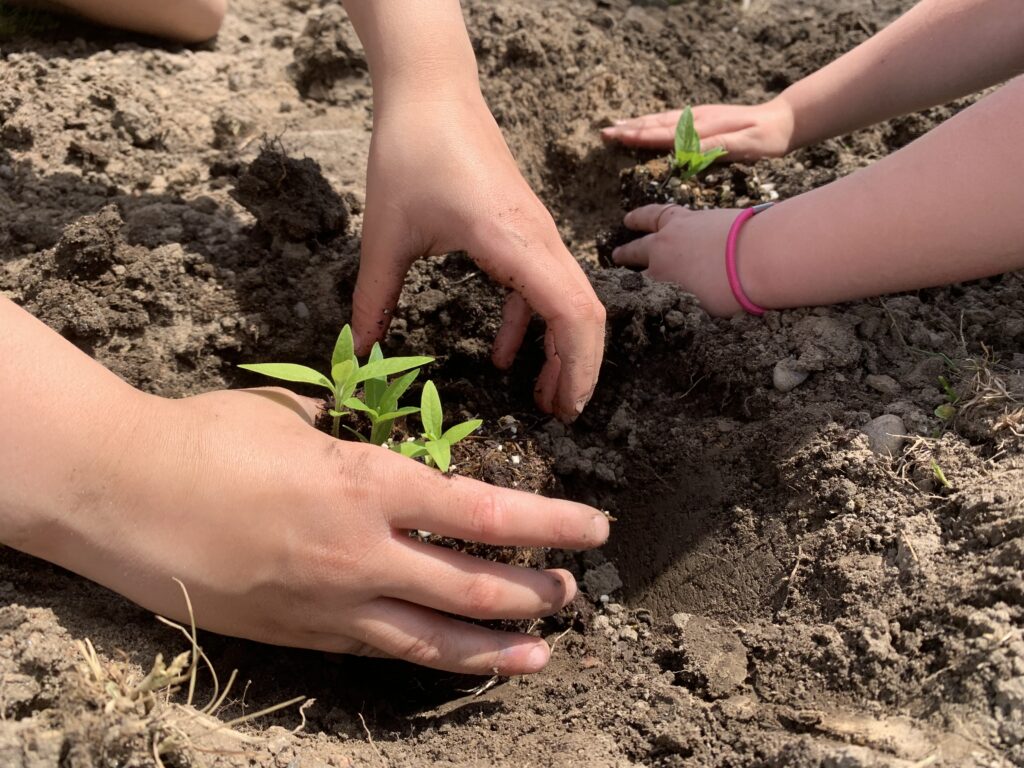
Our vision was led by a grade 3-4 class, and the “Buckhorn Changemakers.” This group of primary and junior students came together around the idea of making our school community a better place for all: for the people at our school and the community, but equally, the forest and schoolyard ecosystems we are in community with, too.
The first part of our vision was to help rehabilitate the school gardens ecosystem, and grow food in a sustainable, regenerative way. Another of the priorities the students identified is to have food that we grow in our very own school gardens nourish our community through the school’s breakfast and hot lunch programs.
Action
Taking these pieces together, our proposed project involved:
-Planting native perennials (such as berries) which sequester carbon, maintain fungal networks in the soil, create habitat for native pollinators, prevent erosion, and provide food – both for humans and other animals.
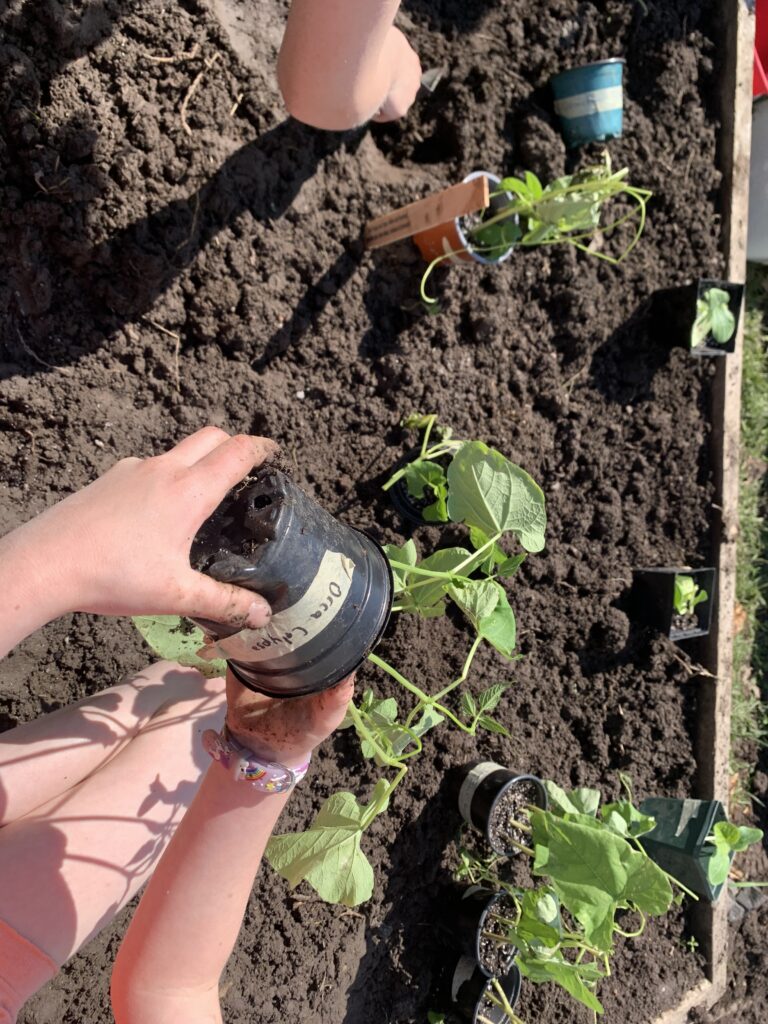
-Reviving the gardens as no-till beds for annual vegetables to maintain moisture in the soil, re-establish fungal networks, and to build soil health more broadly. This is also an important feature of school gardens, which need to retain water and suppress weeds in summer months when garden maintenance is less regular.
-Feeding the school! After the fall harvest, we came together as a school to make a hearty “stone soup,” and held a school-wide harvest feast to share food and gratitude together. The soup was prepared and cooked collaboratively by students and family members, and made not not only from vegetables from our garden, but also contributions of vegetables and seasoning from the school community – including locally tended and harvested mnoomin (wild rice).
Reflection & Celebration
The most important part of this project is grounded in the idea that growing gardens has also helped to change the way we understand our relationship with the Earth. We did not, however, come to understand this, or any of these priorities for our school gardens all on our own: there are many Elders and Knowledge Keepers to thank for the knowledge and wisdom they have shared with us along the way through videos, essays, and virtual visits to our class. It is because of these people that the students understand the connections between colonization and the need for restoration of habitats, cultures, food systems and languages. If we are serious about addressing ecosystem restoration, regenerative agriculture, or climate change, we know that all of this work must prioritize Indigenous Peoples and knowledge.
We would like to extend our deepest gratitude to Elder Melody Crowe for her visit with our class, as well as Caleb Musgrave, Isaac Murdoch for your educational podcasts and videos, and also contributors to the Earth to Tables Legacies project, including Rick Hill, Chandra Maracle, and Ryan DeCaire. The children have identified each of you as meaningful teachers to them, and offer you their gratitude and appreciation. Thank you also to Minikaan Innovation & Design for entrusting us with growing these seeds. Much gratitude to all. Chi miigwech. Nia:wen’kó:wa.
We also give our thanks to Meghan Arnott and Noreen Goodliff, coordinators of the intergenerational gardening program at the Buckhorn Community Centre, as well as Buckhorn P.S. educator and farmer Lynda Jackson.
We look forward to continuing to build relationships and sow the seeds for collaboration in this garden, and ensuring that children, teachers, parents/guardians, and community members of all kinds (including those with feathers or wings, and many legs!) can come together in this beautiful, living space.
Birioukov-Brant, A., Burns, H. (Eds.) (2025). Manoomin Curriculum. Trent University. https://www.trentu.ca/education/sites/trentu.ca.education/files/documents/ManoominCurriculum_Resources_revMay2025.pdf
DeCaire, R., R. Hill, & C. Maracle (Accessed February 2025). ‘Haudenosaunee Gifts’ in Earth to Tables Legacies (Barndt, D., L. Baker, A. Gelis, Eds.) https://earthtotables.org/essays/haudenosaunee-gifts/
DeCaire, R., & C. Maracle (Accessed February 2025). ‘The Thanksgiving Address: Greetings and Thanks to All Life That Sustains Us’ [Video] in Earth to Tables Legacies (Barndt, D., L. Baker, A. Gelis, Eds.) https://earthtotables.org/essays/the-thanksgiving-address/
DeCaire, R. (2023). ‘A Worldview in Verbs’ in Earth to Tables Legacies (Barndt, D., L. Baker, A. Gelis, Eds.) Rowan & Littlefield.
Garcia, F. & D. Kretschmar (Accessed February 2025). ‘The Soil is Alive’ [Video] in Earth to Tables Legacies (Barndt, D., L. Baker, & A. Gelis Eds.) https://earthtotables.org/essays/the-soil-is-alive/
The Good Stuff with Mary Berg (September 29, 2023). Go foraging with a pro Caleb Musgrave [Video]. Youtube. https://www.youtube.com/watch?v=tX2KWSdkLrQ
Hill, R. (Accessed February 2025). Getting to Know Us: Haudenosaunee Primer Video #1 [Video] in Earth to Tables Legacies (Barndt, D., L. Baker, A. Gelis, Eds.) https://earthtotables.org/essays/getting-to-know-us/
Hill, R. (Accessed February 2025). Living With Your Mother: The Great Dish. Haudenosaunee Primer Video #2 [Video] in Earth to Tables Legacies (Barndt, D., L. Baker, A. Gelis, Eds.) https://earthtotables.org/essays/living-with-your-mother-the-great-dish/
Hill, R. (Accessed February 2025). Life in the Longhouse: Haudenosaunee Primer Video #3 [Video] in Earth to Tables Legacies (Barndt, D., L. Baker, A. Gelis, Eds.) https://earthtotables.org/essays/life-in-the-longhouse/
Musgrave, C. (Host). (2023, January 18). Food Forests (no. 128) [Audio Podcast Episode]. In The Canadian Bushcraft Podcast. Apple Podcasts. https://podcasts.apple.com/ca/podcast/ep-128-food-forests/id1508024616?i=1000595306464
Musgrave, C. (Host). (2023, February 8). 10 Crops to Grow. (no. 130) [Audio Podcast Episode]. In The Canadian Bushcraft Podcast. Apple Podcasts. https://podcasts.apple.com/ca/podcast/ep-130-top-10-crops-to-grow/id1508024616?i=1000598627562
Williams, J. (16 March, 2025). Painting Red Feather Woman With Isaac Murdoch [Video]. Youtube. https://www.youtube.com/watch?v=M3ykyzDQg90